

The History of Self-Adhesive Labels (and How They Became Essential for Modern Business)
Self-adhesive labels are a small but essential part of modern commerce. From shipping parcels and printing barcodes to labelling retail products and organising stock, labels help businesses track, identify, and present goods quickly and accurately.
Today, labels are available in many formats, including rolls of labels for thermal label printers, Direct Thermal Labels for shipping, and labels on A4 sheets for standard office printers. They are also supported by equipment such as label dispensers and consumables like thermal transfer ink ribbons.
But the technology behind these everyday products began with a simple invention in the 1930s.
Labelling Before Self-Adhesive Labels
Before the invention of pressure-sensitive labels, labelling products was far more complicated.
Businesses typically used plain paper labels that required glue to be applied separately before attaching them to packaging or products. This process created several problems:
- Glue had to be applied manually or with brushes and rollers
- Labels were slow to apply, particularly in larger quantities
- Excess adhesive created mess and waste
- The process was difficult to automate
As manufacturing and retail expanded in the early 20th century, businesses needed a cleaner and faster way to label goods.
The solution would come from an inventor who recognised that labelling could be made dramatically simpler.
The Invention of the Self-Adhesive Label
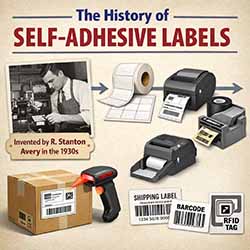
The modern self-adhesive label was invented in 1935 by R. Stanton Avery.
Working from a small workshop in Los Angeles, Avery developed the concept of a pressure-sensitive label, a label that already had adhesive applied and could simply be peeled from a backing sheet and stuck onto a surface.
His invention consisted of three key layers:
1. Face material – the label itself, usually paper or film
2. Pressure-sensitive adhesive – the sticky layer that bonds the label to a surface
3. Release liner – a specially coated backing that allows the label to peel away easily
Avery even built the first machine capable of producing these labels, cutting them and applying them to a backing material so they could be dispensed quickly.
This innovation dramatically simplified the labelling process and led to the founding of Avery Dennison, which would become one of the largest labelling material manufacturers in the world.
The Growth of the Self-Adhesive Label Industry
Once self-adhesive labels were introduced, their advantages became clear. Businesses could apply labels much faster, with less mess and far greater consistency.
Over the following decades, the industry grew rapidly.
1940s–1950s: Early Commercial Adoption
Manufacturers began adopting pressure-sensitive labels for product packaging and identification. Early labels were typically made from paper with rubber-based adhesives.
Although simple, compared with modern labels, they were already significantly easier to apply than traditional glue-applied labels.
1960s–1970s: Improved Adhesives and Materials
Advances in adhesive technology led to the development of acrylic adhesives, which offered better durability and resistance to heat, moisture, and chemicals.
At the same time, new label materials such as polypropylene and polyester films allowed labels to be used in more demanding environments.
These developments helped labels expand beyond retail packaging into industries such as manufacturing, chemicals, and pharmaceuticals.
Rolls of Labels and Automated Labelling
One of the most important developments in the label industry was the production of labels supplied on rolls.
Roll labels made it possible to feed labels through automated machinery and apply them quickly to products and packaging.
Today, rolls of labels are widely used with:
- Thermal label printers
- Automated labelling machines
- Manual and automatic label dispensers
Label dispensers make it easy for operators to peel labels quickly from the backing liner, improving speed and efficiency in packing and production environments.
Roll labels are commonly used for:
- Shipping and courier labels
- Barcode labels
- Warehouse identification
- Product packaging
- Inventory tracking
Because they are compatible with automated equipment, roll labels are ideal for businesses that need to apply labels at high volumes.
Sheet Labels for Flexible Printing
While rolls dominate industrial environments, labels on sheets remain extremely popular in offices and small businesses.
Sheet labels are typically supplied on A4 sheets and can be printed using standard desktop printers such as laser or inkjet machines.
This makes them ideal for smaller print runs and flexible labelling tasks.
Common uses for sheet labels include:
- Address labels
- Product labels for small batches
- File and archive labels
- Packaging labels
- Organisation and storage labels
Because they do not require specialised equipment, sheet labels provide a convenient and affordable labelling solution for many businesses.
The Rise of Thermal Label Printing
In recent decades, one of the biggest innovations in the label industry has been the growth of thermal label printing technology.
Thermal label printers are widely used in logistics, retail, healthcare, and manufacturing because they produce labels quickly and reliably without the need for traditional ink cartridges.
Instead, they use heat to create the printed image.
There are two main thermal printing methods used with label rolls.
Direct Thermal Labels
Direct Thermal Labels are widely used in shipping and logistics.
These labels have a heat-sensitive coating that turns black when heated by the print head of a thermal printer.
This means they can be printed without ink or ribbons, making them simple and cost-effective.
Direct thermal labels are commonly used for:
- Shipping labels
- Courier labels
- Parcel tracking labels
- Warehouse barcode labels
- Temporary product identification
Because the print is created by heat-sensitive material, it can fade over time or when exposed to heat and sunlight. For this reason, direct thermal labels are typically used for short-term applications such as shipping and logistics.
Thermal Transfer Labels and Ink Ribbons
For applications that require long-lasting prints, thermal transfer printing is often used.
This method uses ink ribbons that melt ink onto the surface of the label when heated by the printer.
Thermal transfer labels offer several advantages:
- Long-lasting, durable print
- Resistance to heat, moisture, and chemicals
- High-quality barcodes and text
- Suitable for industrial and outdoor environments
Thermal transfer printing is commonly used for:
- Product identification labels
- Asset tracking labels
- Compliance labels
- Industrial barcodes
- Long-term inventory tracking
By selecting the correct label material and ink ribbon combination, businesses can create extremely durable labels for demanding applications.
Label Dispensers and Efficient Labelling
In many environments, labels are applied manually rather than by fully automated machines.
In these cases, label dispensers provide a simple and effective solution.
Label dispensers automatically peel the label away from the backing liner, allowing the operator to remove and apply the label quickly. This improves both speed and consistency during packing and labelling tasks.
They are commonly used in:
- Warehouses
- eCommerce fulfilment centres
- Production lines
- Packaging departments
When used with rolls of labels, label dispensers can significantly increase labelling efficiency.
Self-Adhesive Labels in Today’s Businesses
Today, self-adhesive labels are used across virtually every industry.
They support essential business processes such as:
- Product identification
- Shipping and logistics
- Barcode scanning
- Inventory management
- Food and regulatory labelling
- Retail packaging and branding
Businesses can now choose from a huge range of label formats, including:
- Roll labels for thermal printers and automated systems
- Direct thermal labels for shipping and logistics
- Thermal transfer labels used with ink ribbons for durability
- A4 sheet labels for desktop printing
Combined with modern thermal label printers and label dispensers, these labels allow businesses to print and apply labels quickly, accurately, and efficiently.
A Small Invention That Changed Packaging
What began as a simple idea in a small workshop in Los Angeles has become a global industry.
The invention of the self-adhesive label by R. Stanton Avery transformed how businesses label, track, and package products. Today, billions of labels are produced every day, supporting everything from online retail and parcel delivery to manufacturing and healthcare.
Nearly a century later, the core concept remains the same: a label that can simply be peeled from its backing and applied instantly.
It’s a simple idea, but one that continues to power modern commerce.