

Variable Data Label Printing Explained: Numbers, Barcodes & Spreadsheet Integration
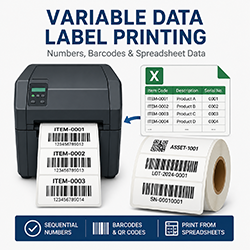
One of the main advantages of variable data printing is the ability to link your label design to a spreadsheet. Each row in your data becomes a new field on your label, making it easy to produce large batches of unique labels quickly and accurately.
Typical uses include:
- Product codes and barcodes
- Batch and lot numbers
- Customer delivery details
- Asset tracking information
You can also print address labels using mail merge in Microsoft Word, provided your spreadsheet is set up correctly (with each line of the address in a separate column).
Sequential Numbering and Barcodes
Sequential numbering is widely used across many industries. You can automatically generate number sequences for:
- Tickets
- Inventory tracking
- Serial numbers
- Compliance labels
You can also add prefixes or suffixes (for example, ITEM-0001-UK), giving your labels more meaning and structure.
Barcodes can be generated alongside this data, allowing for fast and accurate scanning in warehouses, retail, and logistics environments.
Label Materials and Print Methods
Variable data labels can be printed on a variety of materials depending on your needs:
- Direct Thermal Labels
Ideal for short-term applications such as shipping labels. These do not require a ribbon. - Thermal Transfer Labels
Suitable for longer-lasting labels. These must be printed using a thermal transfer ink ribbon. - Synthetic Labels (e.g. polypropylene or polyester)
Designed for durability and resistance to water, chemicals, and abrasion. These also require a thermal transfer ribbon for printing.
Choosing the right material depends on how and where the label will be used.
Printing and Application Equipment
Variable data labels are printed using a label printer, which is specifically designed to handle roll labels efficiently.
Once printed, labels can be:
- Rewound onto cardboard cores using a label rewinder
- Applied using a label applicator gun
- Dispensed using a semi-automatic label dispenser
This helps streamline your labelling process from printing through to application.
Label Design Software
To make variable data printing straightforward, many businesses use specialist label design software such as:
These tools allow you to:
- Connect directly to spreadsheet data
- Generate sequential numbering automatically
- Add prefixes or suffixes
- Create barcodes with ease
- Design professional label layouts
They simplify what could otherwise be a complex process.
Common Applications of Variable Data Labels
Variable data labels are widely used across many industries, including:
- Logistics and Shipping – Address labels and tracking barcodes
- Manufacturing – Batch numbers, serial numbers, compliance labels
- Retail – Pricing and product identification
- Warehousing – Stock control and location labels
- Healthcare – Patient identification and specimen tracking
- Events – Tickets with unique numbering or QR codes
Their flexibility makes them invaluable wherever unique identification is required.
Final Thoughts
Variable data label printing offers a powerful way to improve accuracy, efficiency, and traceability within your business. Whether you're printing sequential numbers, barcodes, or spreadsheet-driven data, the right combination of printer, materials, and software will make the process seamless.
By using tools like BarTender, EnLabel, or even Microsoft Word for simple mail merge tasks, businesses can produce professional, customised labels with ease.
If you're looking to streamline your labelling process, variable data printing is a smart and scalable solution.