

Digital vs Flexo Printing for Labels: Which Is Right for Your Business?
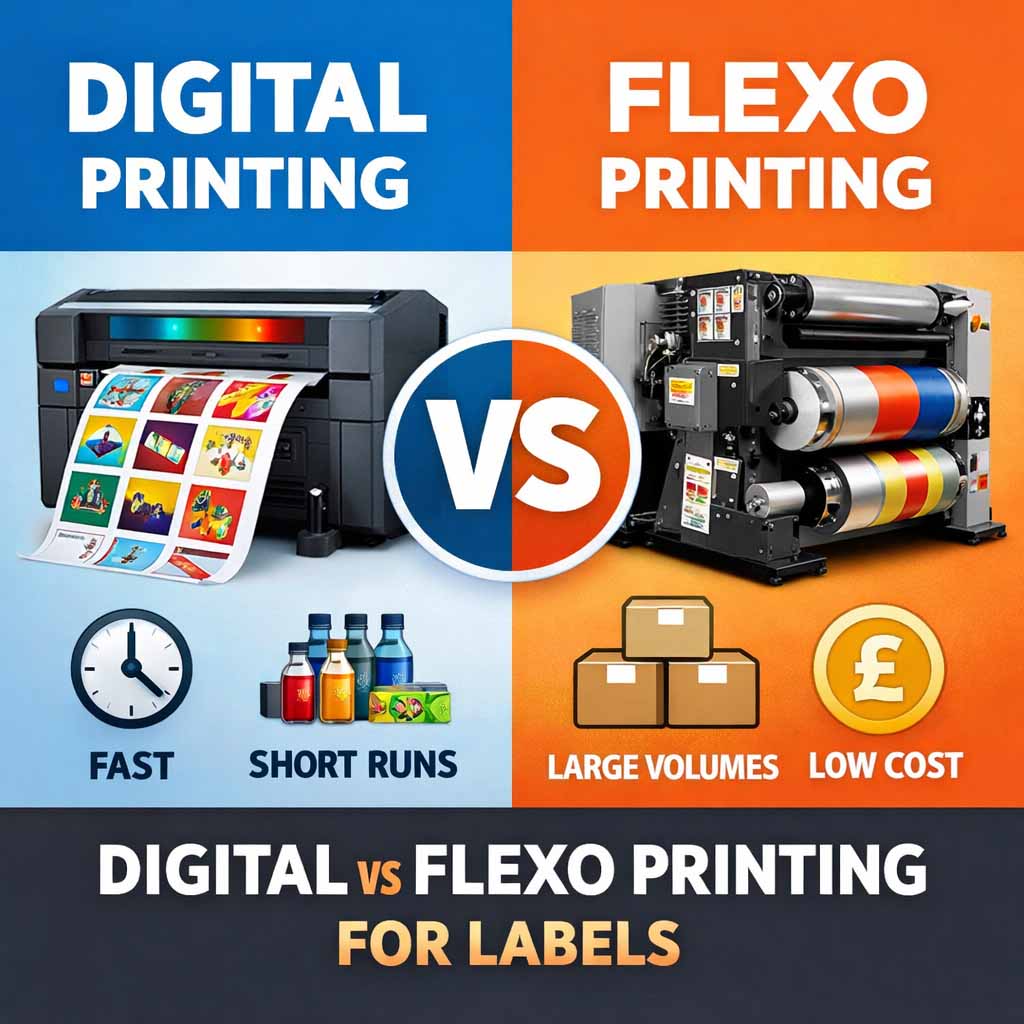
When it comes to ordering labels, one of the most important decisions you’ll make is how they’re printed. The two most common methods are digital printing and flexographic (flexo) printing—but which one is best for your needs?
In this guide, we’ll break down the differences, advantages, and ideal use cases so you can choose the right option with confidence.
What Is Digital Label Printing?
Digital printing is a modern method that works much like a high-end office printer—but on an industrial scale. Designs are printed directly onto the label material without the need for printing plates.
Key benefits of digital printing:
- No setup costs (no plates required)
- Ideal for short runs
- Quick turnaround times
- Easy to customise designs
- High-quality, full-colour printing
This makes digital printing perfect for small businesses, startups, and product testing.
What Is Flexographic (Flexo) Printing?
Flexographic printing is a traditional method that uses physical printing plates mounted on rotating cylinders. Each colour requires its own plate, and the process is designed for speed and consistency.
Key benefits of flexo printing:
- Cost-effective for large volumes
- Very fast production speeds
- Consistent colour matching (great for brand colours)
- Works well on a wide range of materials
Flexo is often used by established brands producing labels in bulk.
Digital vs Flexo: Key Differences
1. Setup Costs
- Digital: No setup costs
- Flexo: Plate costs required (can be significant upfront)
✅ Winner: Digital (especially for small runs)
2. Order Quantity
- Digital: Best for low to medium volumes
- Flexo: Becomes cheaper at high volumes
✅ Winner: Depends on quantity
- Small orders → Digital
- Large orders → Flexo
3. Turnaround Time
- Digital: Fast (no setup needed)
- Flexo: Slower due to plate creation and setup
✅ Winner: Digital
4. Print Quality
- Digital: Excellent for detailed, multi-colour designs
- Flexo: Excellent for solid colours and simple designs
✅ Winner: Tie (depends on design)
5. Design Flexibility
- Digital: Easy to change designs between runs
- Flexo: Changes require new plates
✅ Winner: Digital
6. Cost Per Label
- Digital: Higher per label at scale
- Flexo: Lower per label at high volumes
✅ Winner: Flexo (for large runs)
When Should You Choose Digital Printing?
Digital printing is the best choice if you:
- Are ordering small to medium quantities
- Need labels quickly
- Have multiple designs or variations
- Want to test a new product
- Run a small or growing business
It’s ideal for flexibility and lower upfront investment.
When Should You Choose Flexo Printing?
Flexo printing is better suited if you:
- Need large quantities of labels
- Have a consistent, long-term design
- Want the lowest cost per label at scale
- Require precise colour matching for branding
It’s built for efficiency and volume.
A Simple Rule of Thumb
- Under ~5,000–10,000 labels? → Go digital
- Over that, with repeat orders? → Flexo may be more cost-effective
Final Thoughts
There’s no one-size-fits-all answer—both digital and flexo printing have their place.
- Digital printing gives you flexibility, speed, and low upfront costs
- Flexo printing delivers efficiency and savings at scale
The right choice depends on your order size, budget, and business stage.
Need Help Choosing the Right Labels?
If you’re unsure which option is best for your products, we’re happy to help. Whether you need a small test run or high-volume production, we can guide you to the most cost-effective solution.